

CALL FOR PAPERS
May 28-30, 2027
ICAIE 2027 starts to call for papers!
CFP fLyer download
Please download the CFP flyer and circulate it!
paper Submission
We sincerely invite you to participate in ICAIE 2027 in Bangkok, Thailand!
ICAIE 2027, 2027 International Conference on Artificial Intelligence and Education, will be held in Bangkok, Thailand during May 28-30, 2027. The theme of this year is "AI In and Beyond the Classroom: Learning, Enterprise and Society". ICAIE will keep working on itself as an event whose aim is to provide this chance and platform for researchers from academia, industry, and government institutions to exchange and present novel research on Artificial Intelligence and Education. ICAIE now openly calls for submissions. We warmly welcome researchers and students to actively contribute their papers and join this grand academic conference!
Important Dates
Full Paper Submission Deadline: December 25, 2026
Paper Decision Notification: January 25, 2027
Presentation Abstract (For Presentation Only) Submission Deadline: January 15, 2027
Abstract Decision Notification: 10 working days
Camera-Ready / Registration Deadline: February 10, 2027
Conference Dates: May 28-30, 2027
 Awards
Following a strict and professional review process, several awards will be presented (Read More) .
Join the Committee to Help Review Papers!
Welcome senior scholars and researchers to join ICAIE conference committee to help review papers. Applicants need to send your CV to icaie_conf@163.com.
Conference Proceedings
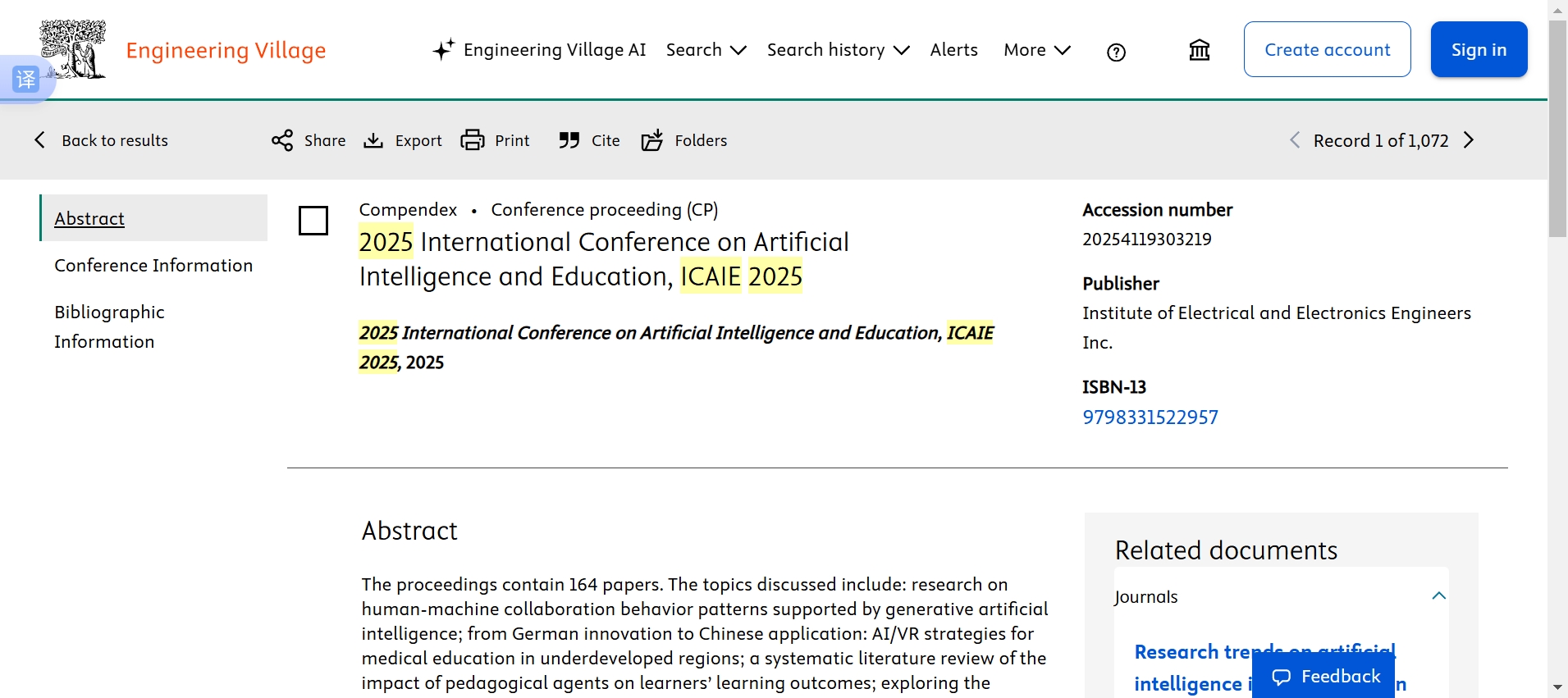
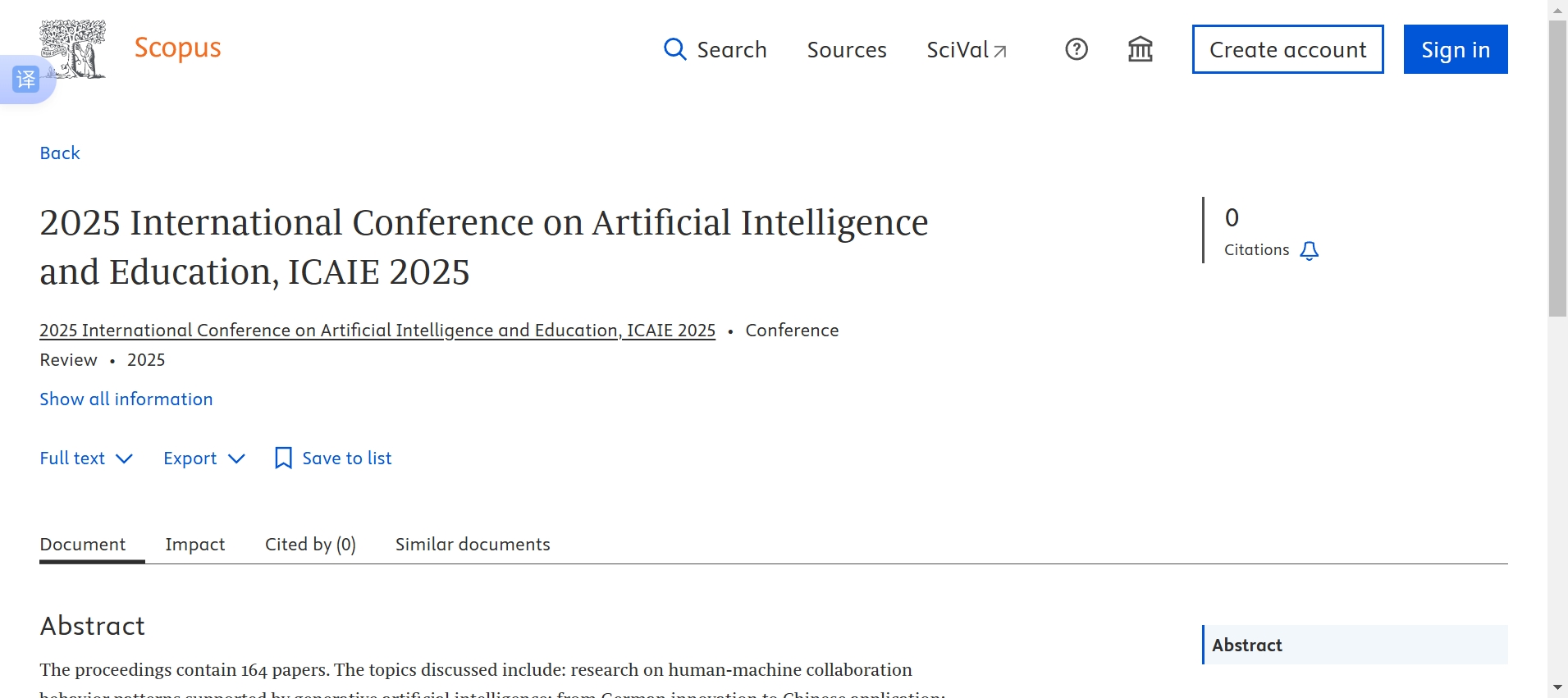
Submitted papers will be strictly reviewed by the technical program committee. Accepted papers after successful registration and presentation will be included in Conference Proceedings, and submitted for indexing by Ei Compendex and Scopus. The authors of the papers will be invited to participate in the ICAIE to display their research results.
Publication History:
ICAIE2026 Conference Proceedings- ISBN: 979-8-3195-2166-8
ICAIE2025 Conference Proceedings- ISBN: 979-8-3315-2294-0 | IEEE Xplore Online | Ei Compendex | Scopus

Journal
Selected excellent papers will be recommended to below Education Technology Top Journals (SSCI, Q1)
1. British Journal of Educational Technology (Online ISSN: 1467-8535, Print ISSN: 0007-1013)
Indexed by: SCOPUS (Elsevier), INSPEC (IET), British Education Index (EBSCO Publishing), Education Collection (ProQuest), etc.,
Citation Impact:
2025 CiteScore (Scopus): 23.1
2025 Journal Citation Indicator (Clarivate): 4.17
2025 Journal Impact Factor (Clarivate): 13


2. Australasian Journal of Educational Technology (AJET)
The Australasian Journal of Educational Technology (AJET) aims to promote research and scholarship on the integration of technology in tertiary education, promote effective practice, and inform policy. The journal is published by ASCILITE, the Australasian Society for Computers in Learning in Tertiary Education.
It aims to promote research and scholarship on the integration of technology in tertiary education, promote effective practice, and inform policy.
AJET welcomes previously unpublished manuscripts that advance understanding of educational technology in post-school education settings, including higher and further education, lifelong learning, and training.
Indexed by: SCOPUS, Thomson Reuters Web of Science, EDITLib, the ACER Blended Online Learning and Distance Education research bank and EBSCOhost Electronic Journals Service.
Currently AJET has the following impact metrics (as at April 2025):
JCR Impact Factor = 3.3 (Q1)
SJR Impact Factor = 1.249 (Q1)
Google Scholar = 14/20 Educational Technology Journals
Scopus CiteScore = 7.6

3. European Journal of Education (Online ISSN:1465-3435, Print ISSN:0141-8211)
European Journal of Education aspires to make an impact within and beyond academia, and covers all areas of educational research from global contributors. Our scope is broad, international and multidisciplinary, spanning from early years education to adult and continuing education. The journal covers education in all subject areas, as well as papers on topics such as educational psychology, policy, sociology, the curriculum, and learning environments and disabilities.
Indexed by: SCOPUS (Elsevier), British Education Index (EBSCO Publishing), Education Collection (ProQuest), etc.,
Citation Impact:
2025 CiteScore (Scopus): 5
2025 Journal Citation Indicator (Clarivate): 2.1
2025 Journal Impact Factor (Clarivate): 5.3

4. Future in Educational Research (FER, Online ISSN:2835-9402)
Future in Educational Research (FER) is a comprehensive journal that publishes studies that focus on new trends, theories, policies and developments in the field of education. Its aim is to bridge the present and the future of educational research, and lead practitioners to create the future of education based on scientific and justifiable evidence.
Indexed by: Web of Science (Clarivate Analytics), Directory of Open Access Journals (DOAJ), Emerging Sources Citation Index (Clarivate Analytics)